Be Careful What You Say – Intellectual Property and Unjustified Threats
In 2023, a London cyclist, who posts footage to a YouTube Channel under the name...
Read more
Registering a trade mark in the United Kingdom is essential if you want to properly protect the identity and reputation of your brand. However, obtaining a trade mark registration is not always straightforward and there are pitfalls to try and avoid. Understanding the UK trade mark opposition system is critical, both for applicants wanting to register a mark and for rights holders who may want to stop a mark mark from registering.
This guide outlines the UK opposition process from start to finish, covering the key stages, procedural requirements, strategic considerations and available legal remedies.
It is written for anyone who needs a practical understanding of what to expect if their application for registration has been opposed, or if they wish to challenge a competitor’s application and stop it from registering.
A trade mark opposition is a formal objection to the registration of a trade mark.
The opposition is lodged by an interested party (usually this will be the holder of one or more earlier rights) who believes that the contested trade mark application conflicts with their earlier right or rights, or otherwise that the application fails to meet the requirements for registration under UK law.
Oppositions may be filed against UK national applications or against international registrations that designate the UK under the Madrid Protocol.
Once a trade mark application is formally accepted by the UK Intellectual Property Office (UKIPO) for registration (i.e. that the mark is capable of registration and is both distinctive and non-descriptive of the goods and services) it is published in the UK Trade Marks Journal.
From the date of publication, a two-month period begins during which any party may lodge their opposition to an application.
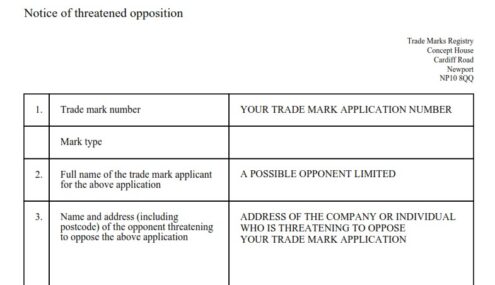
This initial two-month window may be extended by a further month (to a total of three months) by filing a Notice of Threatened Opposition (official Form TM7a).
Serving a Notice of Threatened Opposition does not oblige an interested party to proceed with a full opposition if they later choose not to do so, but it preserves their right to oppose by extending the timeline.
Often, the filing of a Form TM7A can be a good tactic because once submitted the trade mark applicant will be notified of the threat and will know who is threatening to oppose them.
This can often trigger direct communication between the parties and lead to an opportunity for resolving a dispute before formal proceedings take over.
UK law provides for two primary categories of opposition: absolute grounds and relative grounds.
These are not mutually-exclusive.
Absolute Grounds refer to legal objections based on the intrinsic characteristics of the mark at issue.
The most common grounds under this section are that the mark:
Any person may oppose an application on absolute grounds.
Relative Grounds are based on an opponent’s prior rights. These include:
Only the registered proprietor of an earlier right may oppose on the basis of relative grounds.
To formally oppose a trade mark application, the opponent must file a Notice of Opposition & Statement of Grounds (official Form TM7) and pay the applicable fee.
The notice must include:
It is important that the grounds are carefully selected because they would need to be factually supported later.
Additional grounds may sometimes be added to an opposition later in the proceedings, but this would need very good reason and acceptance of a request would be at the discretion of the UKIPO.
In essence, an opponent should endeavour to make its best case from the outset. It is far easier to drop opposition grounds later than it is to add them.
On receipt of an opposition, the UKIPO reviews it for formal compliance.
If accepted, the applicant is duly notified and is set a two-month deadline to file a ‘Defence and Counterstatement’ using official Form TM8.
However, before a counterstatement needs to be filed, both parties may agree to enter an extended cooling-off period if there is any willingness to settle the matter.
Extending the initial period provides a first cooling-off period totalling nine months. This can be extended again by a further nine months prior to its expiry, providing a generous amount of time for the parties to negotiate a potential settlement.
If settlement talks collapse, either party may end the cooling-off early by giving written notice to the UKIPO.
This would then trigger the adversarial rounds of the opposition.
Cooling-off periods are used by parties to try and work out coexistence, facilitated by consent of a mark on the register (and usually its underlying use in the marketplace) subject to conditions being agreed upon.
Where successful these negotiations can resolve a dispute efficiently and cost-effectively, allowing an opposition to be withdrawn in the early stages.
Settlement and coexistence is not always possible or desired by one or both or the parties.
In those instances, an applicant must submit its Defence and Counterstatement in order to formally defend its position.
The counterstatement should:
Failure to respond by the deadline would result in the application being treated as abandoned unless exceptional circumstances can be shown as to why the deadline was missed.
Once the defence is filed, the UKIPO sets a timetable for evidence.
The process typically includes up to three rounds:
All written evidence must be provided in the form of witness statements following a strict legal standard.
The UKIPO imposes a default 300 page limit for evidence, although where merited, permission can be granted for evidence volumes in excess of this.
At the conclusion of the evidence rounds, the parties are given two options:
Following the hearing (or receipt of any final written submissions), the appointed hearing officer will then thoroughly review the case file.
This will include a review of all the evidence and submissions filed by the parties with reference to established case law.
Following the review, the hearing officer will issue a written decision.
At the time of writing, decisions are issued not less than six months following hearings or written submissions in lieu of them.
The UKIPO decision confirms whether an opposition is upheld or rejected.
The outcome may result in:
The decision will usually include a cost award to the successful party.
In order to calculate the level of costs awarded to a successful party, the UKIPO will quote from a published scale of costs.
This scale is intended to keep proceedings ‘proportionate’ although it is important to keep in mind that the level of costs rarely reflect the amount a party may have had to spend.
In some instances a party may request costs on an ‘off the scale’ basis if the proceedings have merited it (for example, if one of the parties has behaved unreasonably) but the ultimate discretion lies with the hearing officer.
The unsuccessful party may appeal within 28 days of the issue date of the written decision.
There are two routes for appeal:
Each route carries different cost and procedural implications, but the Appointed Person appeal route is by far the cheaper option.
The most appropriate path should be chosen carefully by the party wishing to appeal and various factors will come into play when deciding. More often than not, it will come down to cost.
Where several oppositions or invalidity actions involve the same parties or overlapping marks, the UKIPO will usually take it upon themselves to consolidate these cases into a single action.
This is intended to streamline the process by avoiding a level of duplication, thereby reducing time and costs for all concerned.
In recent years, the UKIPO has shown an increasing willingness and tendency to consolidate proceedings, although it must be said this can sometimes be at the slight disadvantage of one of the parties.
The UKIPO has discretion (and often uses it) to call parties to Case Management Conferences to resolve procedural disputes, clarify evidence requirements or to rule on requests for time extensions.
These are akin to ‘mini’ hearings intended to iron out smaller issues that crop up during the course of the proceedings.
Extensions or suspensions of deadlines may be granted with good reason, but are not automatic.
Working with the expertise of a chartered trade mark attorney is invaluable in these circumstances.
Parties that choose to go it alone often struggle and spend inordinate amounts of time on the routine formalities.
Naivety can also lead to a situation where they play into the hands of their adversaries.
Indeed, we would go so far as to say that not having an expert advisor on hand can sometimes mean an applicant or opponent is more likely to snatch defeat from the jaws of victory – particularly if the party on the other side are represented and have a good trade mark attorney working for them.
The best tips we can give are:
For applicants:
For opponents:
For both parties:
The UK trade mark opposition process is a vital mechanism for resolving disputes prior to a mark achieving registration.
The system is accessible and relatively cost-efficient because it is conducted through the administrative UKIPO and not through a court, although it is nonetheless a formal legal process governed by strict rules.
Success often depends on prompt and strategic action, proper preparation of evidence and effective negotiation wherever appropriate.
If you are filing a trade mark application or seeking to oppose one, talking the matter through with a chartered trade mark attorney and then engaging their services can make all the difference between a successful registration (or attack) and a costly setback.
Stevens Hewlett & Perkins regularly handle UK trade mark oppositions for our clients and over the course of time we have seen it all.
We have had many great successes and in some situations we have turned what have looked like hopeless cases from the start into big triumphs for clients.
We understand what it takes and how to strategically manage opposition cases.
If you are facing a potential trade mark opposition or need to stop a conflicting mark from registering then contact our trade mark team today for an initial assessment.
Is your UK trade mark application under threat? Are you thinking of opposing someone else? We can help.
Book a Consultation
In 2023, a London cyclist, who posts footage to a YouTube Channel under the name...
Read more
What happens when you receive a Notice of Threatened Opposition (Form TM7A) from the UK...
Read more