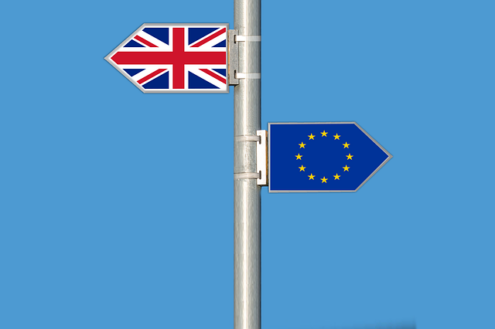
The “Skykick” Case – A Key Decision for Practitioners
On 29 April 2020, the High Court issued a decision that use of the trade...
Read more
Do you (or does your client) own a ‘cloned’ or ‘comparable’ UK trade mark right that was split from an EU trade mark registration (EUTM) at the end of the Brexit transition period?
Since comparable UK rights were born from EUTMs, the UK introduced transitional rules for ‘use’ following Brexit.
Currently, use of the EUTM anywhere in the EU before 1st January 2021 (whether in the UK or elsewhere in the EU) counts as use of the comparable UK right for the purposes of non-use assessments and proof of use requests in UK proceedings.
That made sense, since UK businesses had been operating under a single EU-wide system until the Brexit transition ‘cut-off’.
However, this use principle is time limited.
For any non-use period that covers a date before 1st January 2021, use in the EU (outside the UK) would count as use of the comparable UK mark.
But, after 1st January 2026, since we will be beyond five years following the Brexit transition date of 1st January 2021, it will no longer be possible to rely on use of a mark in the EU to count as use of a UK comparable right.
In other words, the window will shut on 31st December 2025.
On 1st January 2021 (immediately after the Brexit transition ended at 11 p.m. UK time on 31st December 2020), the UK Intellectual Property Office (UKIPO) automatically created a new UK right (called a ‘comparable UK mark’) for every EUTM that was registered at that time.
This ensured continuity of protection in the UK without forcing owners to re-file here.
Every new UK right mirrored the EUTM filing date, goods/services, priority and (where relevant) seniority.
All UK comparable marks have lived independently from the parent EUTMs for almost 5 years.
Under UK trade mark law, if a registration is more than five years old and has not been put to ‘genuine use’ for the registered goods/services then it can be revoked for non-use by any interested party.
Furthermore, if proof of use in UK proceedings is requested (for example, in the course of opposition proceedings brought by the owner of the comparable trade mark), the owner must demonstrate that its mark has been genuinely used in the course of trade for the goods/services for which it is registered. If it cannot, the opposition proceedings would fail.
The term ‘genuine use’ is defined as commercial use that is real and consistent with market practices.
The activity must be seen as the proprietor seeking to create a real and effective customer base in the UK.
From this date, it will no longer be possible to rely on use within the EU to support the use of a UK comparable right.
As of 1st January 2026, revocation applicants and proof of use challengers in UKIPO proceedings can point to a five-year period which post-dates 1st January 2021.
Therefore, use of a mark would have to be in the UK to count.
Use of the mark within the EU would not count.
If the UK mark has not been genuinely used in the UK for the relevant goods/services at any point during the past five years (assessed on or after 1st January 2026), it becomes vulnerable to non-use cancellation.
The immediate consequences can be serious:
There is no universal checklist, but tribunals look for commercial reality: sales, advertising targeted at UK consumers, packaging and labelling, retailer listings, UK website metrics, UK-directed social media, UK customer invoices and import records, etc.
The use must be by the recorded owner or with its consent (e.g., through a licensee).
Sporadic or merely preparatory acts tend not to qualify; small-scale activity can sometimes be sufficient where it is economically justified for the market in question.
We would emphasise that a late-2025 ‘scramble’ to use a mark in the UK might not always qualify as ‘genuine use’ because it may well appear contrived.
When judging UK use, the context (market size, product cycle, lead times and a bona fide product launch) will matter.
From 1st January 2026, non-use analysis for comparable UK trade marks will be considered in a five-year period where only UK use counts.
If the cloned UK comparable mark has not seen genuine UK-directed activity between 2021 – 2025 then it will be exposed to possible cancellation and weakened enforceability.
The solution is simple in theory but requires action: conduct an immediate audit, focus on key areas, ensure genuine application for the UK market and make sure evidence relevant to the UK is at hand if ever needed
Start by reviewing the most important marks and consult with a UK trade mark attorney regulated to practice in the UK.
The output of any review could lead to narrowing specifications, making strategic UK re-filings or speeding up UK launch activities in the final quarter of 2025.
Taking positive action now could save substantial costs and time later.
The deadline is 31st December 2025.
Posted: 12th November 2025